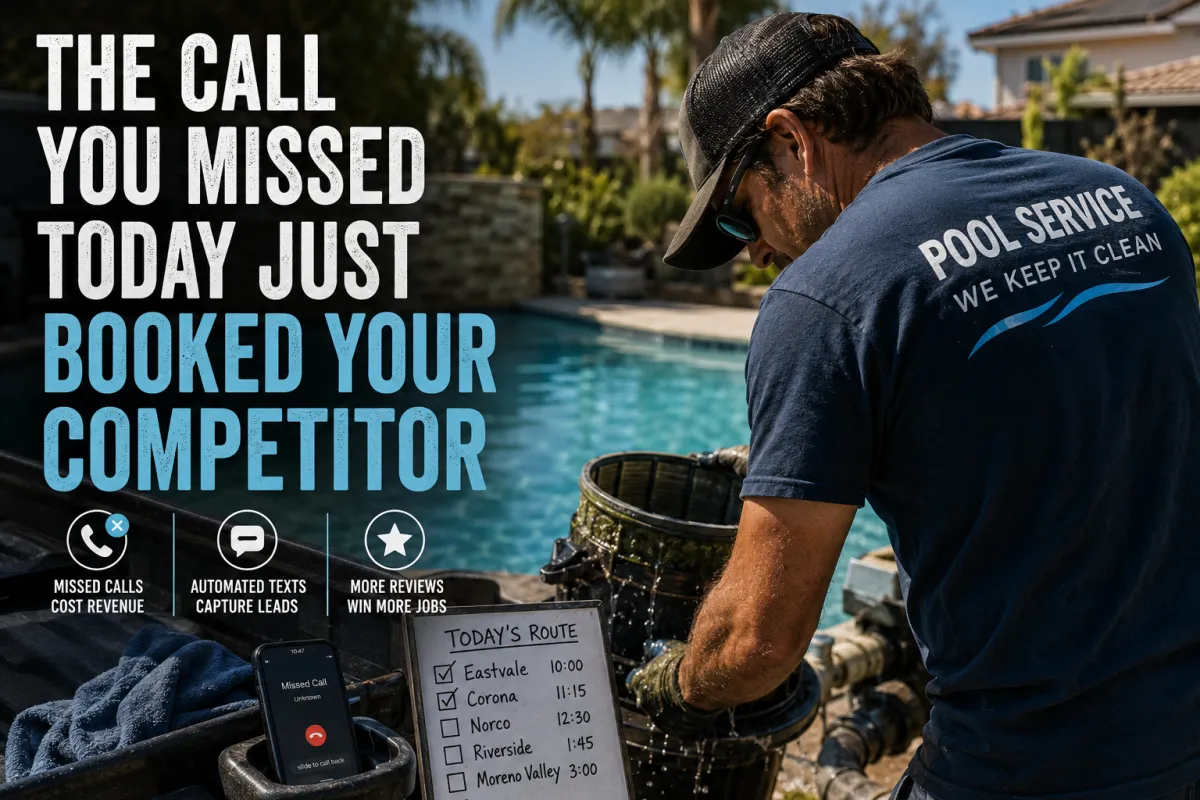
The Call You Missed Today Just Booked Your Competitor
The Call You Missed Today Just Booked Your Competitor
It’s 10:47 on a Tuesday morning. You’re waist-deep in a filter housing in Eastvale, hands covered in algae, phone buzzing in your pocket. You can’t answer. You’ll call back in twenty minutes.
You don’t call back in twenty minutes. By the time you finish the job, load the truck, and drive to Corona, it’s 1:15 pm. You remember the missed call. You dial. It rings out. You leave a voicemail.
They already booked someone else.
That’s not a bad luck story. That’s Tuesday.
The Business Model Nobody Told You About
Pool service is a route business. The economics are simple and good — recurring revenue, repeat accounts, and a customer who needs you back every single week. Once you land a route, it runs. The problem isn’t the work. The problem is everything that happens around the work.
You’re on the water while the phone rings. You’re driving to the next stop when a homeowner searches “pool service near me” and finds your listing. They click. They call. You’re skimming a filter and your phone is in the cupholder.
The lead disappears.
This isn’t a discipline problem or a time management problem. It’s a structural gap — the exact moment your business generates new revenue (an inbound call from a motivated buyer) is the exact moment you’re physically unable to answer it. The route that pays your bills is the same thing blocking you from growing your business.
For most pool techs in California, this gap is invisible. Not because it doesn’t cost them — it costs them constantly — but because the lost lead is silent. The phone rang. Nobody answered. The caller moved on. There’s no invoice saying “missed opportunity: $180/month recurring.” It just never shows up.
What a Missed Call Actually Costs
Let’s put a number on it.
A new pool service account in the Inland Empire or San Diego averages $150–$250 per month. Once you land it, you keep it. Pool customers don’t churn like restaurant diners or retail shoppers — if you do the job, they book you next week without thinking about it.
So a missed call isn’t a one-time loss of $200. It’s a twelve-month loss of $2,400. If you miss two calls a week — conservative for any pool tech running 50+ accounts — that’s nearly $250,000 in lost recurring revenue over five years from calls that rang out while you were on a job.
The instinct is to hire someone to answer the phone. That costs $15–$20/hour, requires management, and creates a whole new problem. The second instinct is to let it go — “most people leave a voicemail.” Most people don’t leave a voicemail. They call the next number on the list.
The Review Problem You’re Probably Not Thinking About
Here’s the thing about missed calls: they’re only half the problem.
When someone in Norco, Rancho Cucamonga, or Carlsbad searches “pool cleaning service,” they don’t just call the first number. They look at reviews. A business with 6 reviews rated 4.1 stars looks like a side hustle. A business with 47 reviews rated 4.8 stars looks like the operator to call.
Most pool techs in California have fewer than 15 Google reviews. Not because their customers are unhappy — by and large, pool service customers are satisfied customers who stay for years — but because nobody ever asked them at the right moment. You finish the job, you leave, and the review never happens.
The operators winning new accounts in your area aren’t necessarily doing better work. They have better review counts. They show up higher in search. They look more established. The gap between a 12-review profile and a 60-review profile is rarely about service quality — it’s about whether anyone ever asked.
What the System Looks Like
The solution to both problems isn’t hiring someone. It’s automation that runs while you’re on the route.
Missed Call Text-Back — the moment a call goes unanswered, an automated text fires within 60 seconds: “Hey, it’s [Your Name] from [Your Business]. Sorry I missed you — I’m out on a job right now. What can I help you with?” The lead is kept alive. They respond in their own time. You follow up when you’re off the water.
Automated Review Requests — after every service, a text goes out asking happy customers to leave a Google review. Not spammy, not annoying — a single message, timed right. Over 90 days, a pool tech with 11 reviews becomes a pool tech with 40+. The effect on inbound call volume is significant and measurable.
Reactivation Campaigns — that customer who stopped responding six months ago? They’re in your database. A simple automated sequence — a check-in message, a seasonal offer — reactivates a portion of dormant accounts every single month. Revenue you already earned once, coming back.
These aren’t complicated tools. They run in the background. You don’t manage them. They work while you’re on a route in 95-degree heat in Moreno Valley.
Where This Leaves You
You built a route business because recurring revenue makes sense. The fundamentals are right. What most California pool techs are missing isn’t a better work ethic or a bigger truck — it’s a system that handles the business development side while they handle the water.
The operators who are growing routes in the Inland Empire, Temecula, and North San Diego right now are mostly not spending more money on marketing. They’re not running ads. They’re just not losing the leads they already generate, and they’re letting their existing customers sell for them through reviews and referrals.
That’s a solvable problem. A simple one, actually.
Find Out Where You’re Losing Revenue
Northmark Digital Systems runs a free TradeOS Revenue Audit for California pool service operators — a quick diagnostic that shows you exactly where leads are slipping through the cracks and what your current customer base is worth if it were working for you.
No obligation. No pitch. Just a clear picture of what your business looks like right now, and what it could look like with the right system behind it.
► Book your free TradeOS Revenue Audit → [Insert Link]